|
The two new novel probes, Aminophenyl fluorescein (APF)
and Hydroxyphenyl fluorescein (HPF) developed by
Tetsuo Nagano et. al. (1), are selective for the
detection of highly reactive oxygen species (hROS).
Both probes have little reactivity towards other ROS
such as: singlet oxygen (021),
superoxide (O2-•),
hydrogen peroxide (H202),
nitric oxide (NO•),
and alkyl peroxide (RO2•)
(see table below)1.
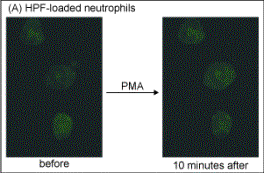
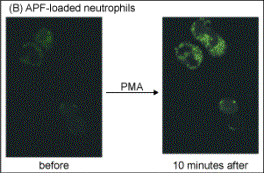
HPF/APF are cell permeable and can be used in
combination to detect hypochlorite (-OCl)
production in cells (see fig 1). Hypochlorite can be
detected by loading two samples, one with APF and
the other with HPF. Hypochlorite production is
visualized by increase in fluorescence of APF loaded
cells and no increase in fluorescence in HPF loaded
cells.
|


 GENTAUR Germany
 GENTAUR Italy
 Česká republika
Praha
Česká republika
Praha Danmark
 Finland Helsset
 Ελλάς Αθήνα
 Ireland Dublin
 Luxembourg
 Magyarország
Budapest
Magyarország
Budapest Nederland
 Norge
Oslo
Norge
Oslo Österreich
 Sverige
Stockholm
Sverige
Stockholm Schweiz Züri
 Canada Montreal
 US New York
 日本
日本